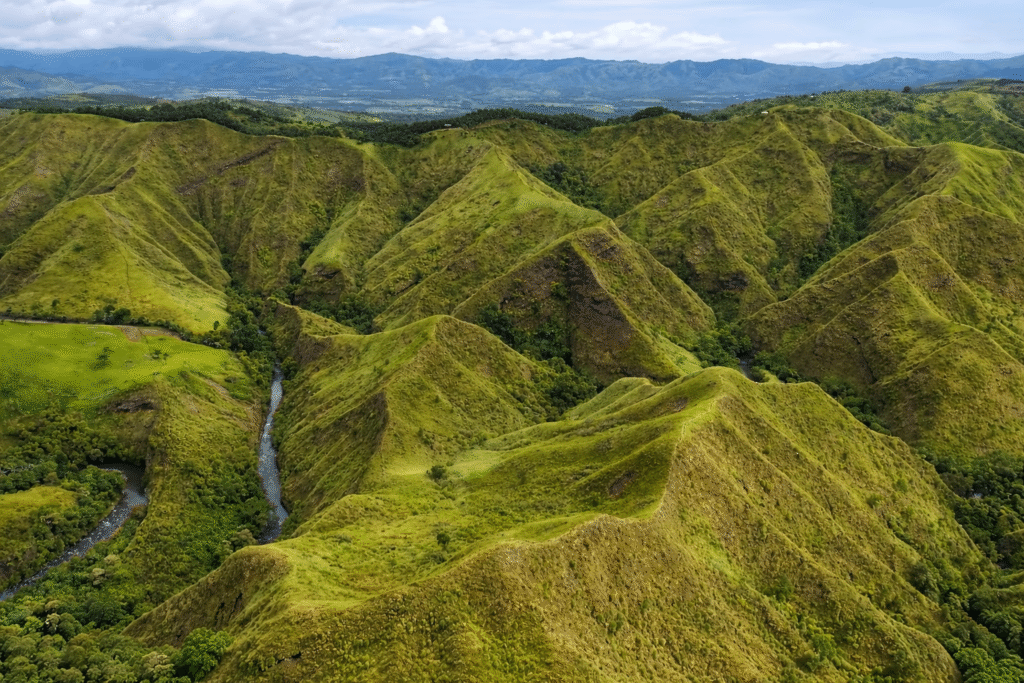
Watershed Collapse & Bald Mountain Restoration
Terrain–Water Repair as the Foundation of Ecological Recovery
Location: Colombio, Sultan Kudarat, Philippines
Program: GeoComms Terrain Engineering PH™ / TrueWatershed™
Bald mountain terrain is characterized by convex ridges, rapid runoff pathways, and limited soil-moisture retention—typical of upland degradation driven by hydrologic imbalance.
Why Bald Mountains Stay Bald
Bald mountains are not suffering from a lack of trees.
They are suffering from a failure to retain water.
Across upland landscapes in Sultan Kudarat and beyond, repeated reforestation efforts have failed—not because trees are unsuitable, but because water leaves the terrain too quickly for life to establish.
When rainfall is converted immediately into runoff:
- Soil moisture collapses
- Erosion accelerates
- Vegetation—no matter how intensively planted—cannot survive
GeoComms approaches restoration from a different starting point:
- Slow the water.
- Stabilize the soil.
- Let trees return naturally.
By repairing how terrain absorbs, stores, and releases water, landscapes regain the conditions required for long-term ecological recovery—without repeated planting failures.
This is not tree planting. This is terrain intelligence.
The GeoComms Terrain–Water Restoration Doctrine
The Problem with Conventional Restoration
Most “bald mountain” rehabilitation programs treat symptoms rather than causes.
Tree planting is applied to terrain that has already lost its hydrologic capacity. When:
- Runoff is uncontrolled
- Soil moisture collapses seasonally
- Gullies continue to deepen
Trees cannot survive—regardless of planting density or budget.
This is not primarily an ecological failure.
It is a terrain–water system failure.
The GeoComms Principle
GeoComms defines restoration as a hydrologic repair problem first, and a biological process second.
Our doctrine is explicit:
Water behavior determines vegetation outcomes
Vegetation does not correct water behavior
Therefore, restoration must follow terrain logic—not planting schedules.
The Four-Phase Doctrine
Phase 1 — Hydrologic Repair
Objective: Slow, spread, and sink water into the landscape
Actions include:
- Contour-aligned soil opening
- Runoff deceleration structures
- Gully arrest and sediment recovery
Outcome: Destructive surface flow is converted into productive subsurface flow
Phase 2 — Soil & Root Stabilization
Objective: Build a living framework that holds moisture and soil
Actions include:
- Pioneer grasses and shrubs with aggressive root systems
- Fire and grazing suppression
- Organic matter accumulation
Outcome: Soil depth, structure, and moisture resilience begin to recover.
Phase 3 — Assisted Natural Regeneration
Objective: Enable trees to survive without artificial support
Actions include:
- Tree establishment only in hydrologically favorable zones
- Native, site-adapted species
- Protection of natural regeneration corridors
Outcome: Trees establish because the terrain is ready—not because they are forced.
Phase 4 — Ridge Recovery (Time-Based)
Objective: Long-term system closure
Key insights:
- Ridges recover last
- Trees migrate upslope naturally as soil and moisture improve
Outcome: A stable, self-maintaining upland system emerges over time.
How GeoComms Measures Success
GeoComms does not measure success by seedling counts.
We track:
- Gully stabilization and retreat
- Dry-season vegetation persistence
- Stream baseflow extension
- Reduced downstream sediment load
When these indicators improve, forest recovery becomes inevitable.
Why This Doctrine Matters
Applied correctly, terrain–water restoration:
- Reduces downstream flooding
- Improves dry-season water security
- Lowers long-term rehabilitation costs
- Creates replicable watershed repair models
This elevates restoration from advocacy to infrastructure-grade land management.
The GeoComms Position
GeoComms does not run tree-planting campaigns.
We deliver:
- Terrain intelligence
- Hydrologic logic
- Watershed-scale decision frameworks
- Operational restoration strategies
Because water security begins upstream—long before trees appear.
UN Alignment Note
This field initiative supports outcomes aligned with:
- SDG 6 – Clean Water and Sanitation (sediment reduction, baseflow stabilization)
- SDG 13 – Climate Action (land resilience and moisture retention)
- SDG 15 – Life on Land (restoration of degraded upland ecosystems)
The approach emphasizes preventive, upstream land–water system repair, consistent with nature-positive and pollution-risk-reduction principles.
Project Status & Transparency
- Type: Field pilot / doctrine validation
- Stage: Early implementation with ongoing monitoring
- Location: Colombio, Sultan Kudarat, Philippines
- Monitoring focus: Hydrologic behavior, soil stability, vegetation persistence
This case is published to document learning and method—not to claim final outcomes.
Doctrine Closing Statement
If water cannot stay, trees cannot live. Fix the water—and the forest returns.