Terrain Stewardship: Learning from Infrastructure Failure
Infrastructure failures are often attributed to materials, workmanship, or maintenance.
Terrain Engineering shows a different truth:
Most road failures are terrain and water failures — not concrete failures.
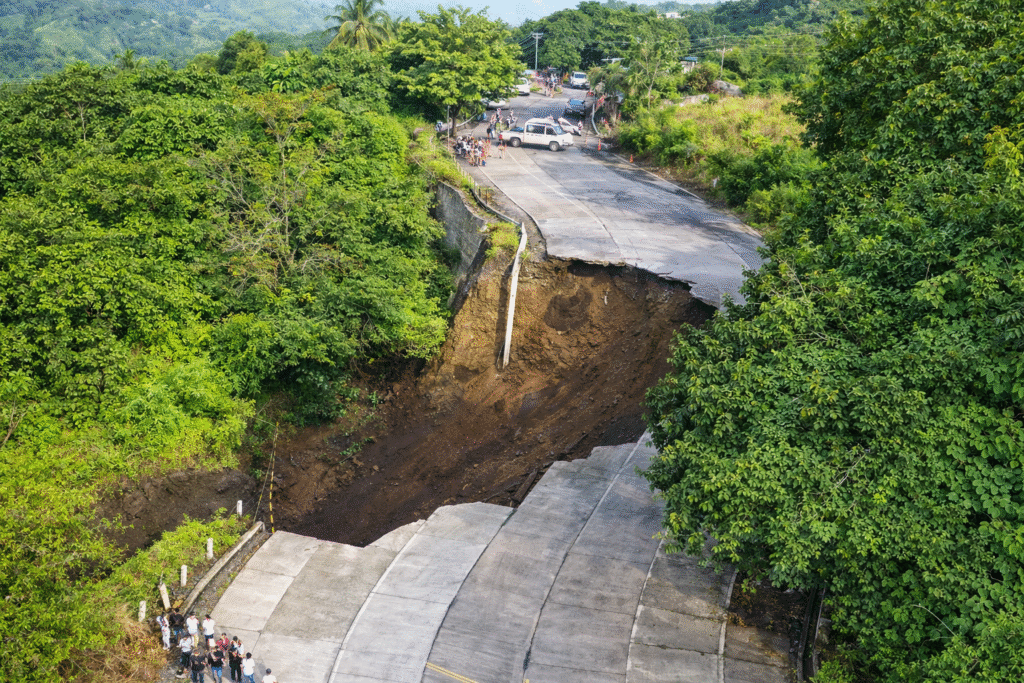
The images illustrate a common and preventable pattern: a road constructed across an active slope–drainage system without sufficient understanding of terrain behavior.
What Happened (Plain Explanation)
Not at the crack—but in the terrain system:
- Hydrologic failure: subsurface water accumulation with no release path
- Slope failure: weakened soils under load
- Planning failure: road alignment ignored natural drainage logic
This is a system failure, not an isolated defect.
Where the Real Failure Occurred
Not at the crack — but in the terrain system:
- Hydrologic failure: subsurface water accumulation with no release path
- Slope failure: weakened soils under load
- Planning failure: road alignment ignored natural drainage logic This is a system failure, not an isolated defect.
Why This Matters for Stewardship
Roads, water, and terrain are inseparable systems.
When infrastructure ignores terrain behavior:
- Risks compound silently
- Failures occur suddenly
- Costs escalate exponentially
- Communities are disrupted
Preventing such failures is a stewardship responsibility, not merely an engineering choice.
Terrain Failure Doctrine (Brief)
Terrain always governs.
Water always follows terrain logic.
Infrastructure must adapt — or fail.
Doctrine principles:
- Watersheds are active systems, not backgrounds
- Subsurface water is as critical as surface flow
- Mid-slope and drainage convergence zones require special care
- Avoidance is preferable to structural correction
- Prevention costs less than repair — socially and economically
What Should Be Done Before Building Roads
Responsible terrain stewardship requires that before construction:
- Micro-watersheds are identified and respected
- Slope stability and hydrology are assessed together
- Road alignments favor ridges over drainage hollows
- Subsurface drainage is planned—not assumed
- High-risk zones are avoided or structurally designed
These steps align directly with risk reduction, resilience, and sustainability goals.
Our Stewardship Position
We do not study failures to assign blame.
We study them to reduce future risk, improve governance decisions, and protect communities.
This approach supports:
- Disaster risk reduction
- Sustainable infrastructure planning
- Evidence-based decision making
- Long-term resilience
Good infrastructure begins with respect for terrain.